Most property managers and asset owners know within 60 to 90 days of a new janitorial contract that something is wrong. Complaints accumulate. Service levels are inconsistent. The facility services management team is hard to reach, and when they are reached, the corrective action conversations produce short-term improvement followed by the same patterns repeating. By month six, the question is no longer whether to fix the situation but how to execute a transition without making things worse.
This post outlines a practical 90-day stabilization framework for commercial properties moving away from an underperforming janitorial cleaning provider. It is designed to be executed without operational disruption, and to produce a measurable, accountable program on the other side rather than simply a different contract.
UG2 manages cleaning contract transitions for commercial and corporate properties across the country. If your current vendor is underperforming, the conversation about what a transition looks like costs nothing.
Evaluate Your Building’s Risk Exposure
Before the 90 Days
Deciding Whether to Fix or Replace
Not every underperforming cleaning program requires a vendor change. Some situations are recoverable through a formal corrective action process, a renegotiated scope, or a change in the vendor’s on-site supervision. Before initiating a transition, it is worth being clear about which category you are in.
The case for working through the existing vendor is strongest when the underperformance is isolated to specific scopes or locations, when the vendor’s leadership has demonstrated both accountability and a concrete improvement plan, and when the underlying issue is scope misalignment rather than execution failure. A contract that was written without a thorough baseline assessment of the property often looks like poor performance when it is actually a poor fit between the scope and the actual conditions.
The case for replacing the facility services provider is clearest when three conditions are simultaneously present: documented complaints that have not produced sustained improvement over a 60-to-90-day period, a pattern of inconsistent or unsupervised staffing at the property, and a vendor who cannot or will not present a corrective action plan with measurable milestones and accountability mechanisms. When all three are present, the cost of continued underperformance in tenant satisfaction, liability exposure, and surface degradation almost always exceeds the cost of a structured transition.
The transition risk that property managers most frequently cite is disruption: the fear that a changeover will temporarily make things worse before they get better. In a well-planned transition executed by an experienced janitorial provider, this risk is manageable and largely avoidable. The greater risk is extending an underperforming contract because the transition feels complicated.
For a full financial model of what that underperformance costs over time, see our breakdown of the true cost of deferred cleaning.
If you manage corporate facilities or headquarters properties, the reputational stakes of prolonged underperformance are particularly high. A single leadership visit or client walk-through during a period of visible cleaning failure can trigger organizational pressure that a structured transition would have avoided entirely.
Days 1 Through 30
Baseline, Scope, and Mobilization
The most common failure mode in janitorial cleaning provider transitions is inheriting the prior vendor’s problems. This happens when the incoming provider takes over the existing scope without first conducting an independent baseline assessment of actual conditions. The scope that the prior vendor was working against may have been misaligned from the beginning. Adopting it uncritically reproduces the same misalignment under a new contract name.
The first 30 days of a successful transition are therefore primarily diagnostic. The incoming provider should conduct a systematic zone-by-zone assessment of the property covering current surface conditions, restroom and common area fixture status, high-touch frequency requirements by area, tenant-specific considerations, building entry and weather vestibule conditions, and any deferred maintenance items that janitorial cleaning staff should document and escalate rather than attempt to remediate through cleaning alone.
Phase 1 | Days 1 to 30
Baseline Assessment and Program Design
This phase includes conducting a zone-by-zone property assessment. Map scope to actual conditions, not inherited contract. Establish initial KPIs and reporting cadence. Communicate transition plan to property management and tenants. Over-staff visible and high-complaint areas to generate early momentum and tenant confidence.
Parallel to the assessment, the first 30 days should include proactive tenant communication. A brief written notice explaining that building management has engaged a new facility services provider, that the transition is designed to be seamless, and that tenant feedback is actively solicited establishes the right tone and creates a helpful feedback channel that will generate useful data in the weeks that follow.
Staffing in this phase should lean toward over-deployment in the building’s highest-visibility and highest-complaint areas. The goal is not to set a sustainable labor model but to generate visible improvement quickly, which builds tenant and ownership confidence in the transition and creates goodwill that makes the calibration phase easier.
- Zone-by-zone baseline assessment documented and delivered to property management
- Scope of work mapped to assessed conditions, not prior contract
- Tenant communication distributed before or on day one of new service
- Initial KPIs established and agreed upon with property management
- Inspection and reporting cadence defined and scheduled
- High-visibility and high-complaint areas identified for intensive first-phase coverage
Days 31 Through 60
Calibration and KPI Establishment
By day 31, the incoming janitorial provider has real data from four to five weeks of actual service delivery at the property. This is the phase where the scope gets calibrated to what the building actually needs rather than what was specified before full conditions were understood.
Some areas will require more frequent service than the initial scope specified. Others, typically back-of-house zones or lower-traffic floors, may require less. The calibration conversation should be data-driven, using the inspection records from the first 30 days to support scope adjustments rather than relying on anecdotal feedback alone. A provider who is tracking inspection pass rates by zone will have objective documentation for this conversation. A provider who is not will be negotiating on impressions.
Phase 2 | Days 31 to 60
Calibration, Feedback Integration, and KPI Baseline
It’s essential to review the first-30-day inspection data and adjust scope by zone. Collect initial tenant satisfaction data and integrate findings. Establish staffing model based on actual traffic and condition patterns. Conduct first formal KPI review with property management. Identify any deferred maintenance items surfaced during cleaning operations and escalate to the appropriate service function.
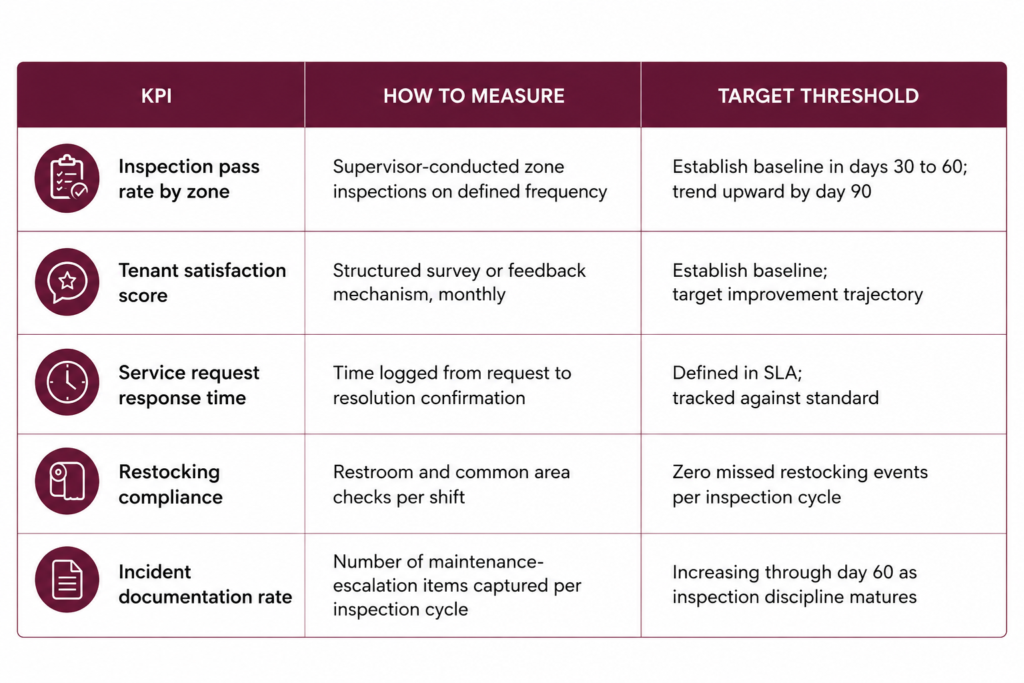
This is also the phase where the formal KPI baseline gets established. The first 30 days produce directional data. The 30-to-60-day period should produce the documented baseline against which all subsequent performance will be measured. Inspection pass rate by zone, tenant satisfaction score, response time to service requests, and restocking compliance in restrooms and common areas should all be quantified and agreed upon with property management before day 60.
For commercial office buildings with multiple tenants, the 30-to-60-day window is also the right time to begin formal tenant satisfaction canvassing if it was not already in place. Tenants who were experiencing problems under the prior vendor will have opinions formed by their first 30 days with the new provider. Capturing those opinions formally while they are still in the early formation stage allows the program to adjust before patterns solidify.
Days 61 Through 90
Stabilization and Forward Program Design
The final phase of the 90-day plan is about converting a stabilized janitorial operation into a forward program design that will hold performance over the full contract term. By day 60, the incoming facility services provider should know the building well enough to design a service model that is appropriately staffed, scoped to actual conditions, and governed by KPIs that have a documented baseline.
Phase 3 | Days 61 to 90
Stabilization, Documentation, and Long-Term Program Design
This phase includes conducting a 60-day KPI review and document performance against baseline. Finalize long-term scope and staffing model. Establish quarterly review cadence with property management. Deliver documented maintenance history for surfaces and fixtures. Present 12-month forward program plan including seasonal adjustments, deep clean scheduling, and capital surface protection recommendations.
The 90-day review conversation with property management should be structured, not anecdotal. The incoming janitorial provider should present documented KPI performance against the baselines established in phase two, a summary of any maintenance-escalation items identified and addressed during the first 90 days, the finalized long-term scope and staffing model, and a 12-month forward calendar that includes seasonal adjustments, scheduled deep cleans, and surface protection milestones.
This documentation serves a purpose beyond the immediate review. It creates the beginning of a maintenance history for the property, which supports asset valuation, capital reserve planning, and due diligence in any future transaction. A cleaning program that produces this level of documentation is functioning as asset protection infrastructure, not just a service contract.
UG2’s approach to facility services is built around this integration between daily cleaning operations and long-term asset management. The 90-day stabilization framework is the entry point into a janitorial program designed to hold performance and generate documentation over the full asset management lifecycle.
What to Demand from Your New Vendor: Non-Negotiables for a Stable Transition
Not all commercial cleaning providers are equipped to execute a structured transition. The capability gap is most visible in four areas, and property managers should assess each before signing a new contract.
The first is the baseline assessment process. A provider who wants to start immediately on the existing scope without conducting an independent assessment is likely to inherit the prior vendor’s problems. The assessment is the foundation of everything that follows. A provider who skips it is signaling something about how they will operate across the full contract term.
The second is KPI infrastructure. A janitorial provider who cannot describe their inspection methodology, reporting cadence, and performance documentation system before contract execution is not operating a KPI-driven program. They are operating a reactive cleaning model under a new name. The difference matters enormously for long-term performance and accountability.
The third is supervision structure. Underperforming cleaning vendors almost always share a common characteristic: insufficient on-site supervision relative to the property’s complexity. Ask specifically about the supervisory ratio, the frequency of management-level presence at the property, and the escalation path for performance issues. A credible answer is specific and verifiable.
The fourth is transition planning experience. Executing a facility services provider transition without disrupting tenants or allowing performance to decline during the handover period requires specific operational expertise. Ask for references from properties where the provider executed a transition from an underperforming incumbent. How they managed those situations is the best available predictor of how they will manage yours.
Across every industry UG2 serves, these four capabilities are the structural foundation of programs that hold performance over time rather than delivering an impressive first 30 days and then regressing toward the same patterns that made the prior vendor relationship untenable.
A cleaning contract transition executed without a baseline assessment, documented KPIs, and a supervision plan is not a solution to vendor underperformance. It is the same problem with a new company name on the invoice.
The Long View: From Stabilization to Asset Protection
The 90-day plan described here is a stabilization framework, not a destination. The goal at day 90 is a program that is running predictably, generating useful performance data, and positioned to improve over time rather than drift toward the patterns that made the prior provider relationship untenable.
Getting to that position requires discipline from both the facility services provider and property management. The provider must maintain the inspection cadence, deliver structured reporting, and treat the KPI review conversations as accountability mechanisms rather than formalities. Property management must engage with those reviews substantively, use the data to drive scope and staffing conversations, and resist the temptation to reduce program investment when the building is running well. Buildings that return to a reactive model after a successful stabilization typically find themselves in the same situation 18 to 24 months later.
The properties that sustain high performance over a full asset management cycle are the ones that treat cleaning services as a continuous investment in the asset rather than a variable cost to be optimized against near-term budget pressure. The 90-day stabilization plan is the mechanism for getting a property onto that trajectory after a period of underperformance. What happens on day 91 and beyond determines whether the transition produced lasting value or simply reset the clock.
If you manage commercial office properties or corporate facilities and are evaluating your current janitorial program against the framework described here, the next step is a conversation about what your building’s conditions actually require and what a structured program would look like in your specific context.
UG2 has executed janitorial cleaning contract transitions for commercial and corporate properties across a range of building types and market conditions. If your current provider is underperforming, we can walk through what a 90-day stabilization plan looks like for your specific property.
Evaluate Your Building’s Risk Exposure
Corporate Facilities | Commercial Buildings | All Industries
Explore UG2’s Facility Services by Property Type
- Corporate Facilities and Headquarters
- Commercial Office Buildings and Mixed-Use Properties
- Full Industry Service Portfolio
- About UG2: Approach and Leadership
- Contact UG2 to Discuss Your Building’s Program
Frequently Asked Questions
How do I know when it is time to replace my janitorial company rather than try to fix the relationship?
The decision point is usually reached when three conditions are present simultaneously: documented complaints that have not produced sustained improvement over a 60-to-90-day period, a pattern of inconsistent or unsupervised staffing at the property, and a [provider who cannot or will not present a corrective action plan with measurable milestones. When all three are true, the cost of continued underperformance in tenant satisfaction, liability exposure, and surface degradation almost always exceeds the cost of a structured transition to a new provider. If only one or two conditions are present, a formal corrective action process through the existing vendor may be the more efficient path.
What does a commercial cleaning transition plan need to include?
A complete transition plan covers five elements: a baseline audit of current conditions by zone, a scope of work mapped to those conditions rather than to the prior contract, a staffing and supervision plan for the incoming janitorial provider, a communication protocol for tenants and property management during the transition period, and a set of measurable KPIs that will govern performance from day one. Transitions that skip the baseline audit are the most common failure mode. Without it, the incoming provider inherits the prior vendor’s scope misalignments and often produces the same outcomes under a new contract name.
How long does it take to stabilize cleaning at an underperforming commercial property?
With a structured plan, visible stabilization typically occurs within the first 30 days when the incoming provider over-deploys in high-visibility and high-complaint areas. The 30-to-60-day window is used to calibrate staffing levels, refine the scope based on actual conditions, and establish the KPI baseline. By day 90, a well-executed transition should have a documented performance record, initial tenant feedback data, and a service model running predictably. Full program maturity, where KPIs are trending consistently and the team knows the building thoroughly, typically follows at the six-month mark.
Will replacing my janitorial company disrupt tenants?
A planned transition managed by an experienced provider can be nearly invisible to tenants. Proactive communication before the transition date, an intensive management presence in the first week, and a commitment to over-delivering on visible areas during the first 30 days combine to make most transitions feel like improvement rather than disruption to occupants. The disruption risk is substantially higher when a transition is unplanned or reactive, which is why addressing vendor underperformance before it reaches a crisis point produces better outcomes for everyone in the building.
What KPIs should I establish when bringing in a new cleaning vendor for a commercial building?
The most useful KPIs to establish for a facility services transition are inspection pass rates by zone on a defined frequency, tenant satisfaction scores collected through a structured feedback mechanism, response time to service requests and reported issues, restroom and common area restocking compliance, and incident documentation rates for maintenance-escalation items identified during janitorial cleaning operations. Establishing these in the first 30 days gives the 60-day and 90-day reviews comparative data to work with. A vendor who resists being held to documented KPIs from day one of a transition is providing useful information about how they intend to operate across the full contract term.