These Themes Are Shaping Decision-Making Across the Industry
As innovators in facility services, we pride ourselves on bringing you the latest industry insights and lessons learned.
That’s why we’ve rounded up our best insights on topics our customers couldn’t stop buzzing about in 2025.
These themes will continue to guide facility services decision-making in 2026. Explore these blog posts for deeper insight, or contact us to start a conversation about how UG2 can support you across each of these focus areas.
Budgeting Constraints and Doing More with Less
One trend of 2025 that isn’t going away for 2026 is the need to maintain the same level of operations with tighter financial constraints. If you’re feeling that same pressure, here are three blogs to add to your list.
1. 4 Key Areas To Optimize Your Facility Services Budget
Key Takeaway: While it can feel like you need to make reactive cuts to make your budget work, that often results in spending more in the long run. A focus on preventative maintenance and strategic investments in technology can help you avoid surprises and maximize savings in the short and long term.
2. Better ROI And Smarter Facilities Outsourcing
Key Takeaway: Outsourcing is about more than handing off tasks. When you choose a partner who acts as an extension of your team and prioritizes the right things—accountability, transparency, and talent development—outsourcing can help you increase efficiency and reduce costs.
3. Top 5 Benefits of Outsourcing Janitorial Services for Your Business
Key Takeaway: Outsourcing janitorial services allows you to focus on your core business and mission without the burden of staffing and management. You benefit from specialized expertise that helps improve cleanliness with an overall lower cost than managing in-house.
Adopting AI-Driven Operations
The use of artificial intelligence continues to evolve in every industry, and the facility services industry is no exception. As we’ve seen throughout 2025, and anticipate will continue throughout 2026 and beyond, a successful AI adoption strategy can propel organizations to new heights.
4. Maximizing AI Potential: A Framework For Success
Key Takeaway: Adopting AI doesn’t start with adopting technologies. It starts with planning, alignment, governance, and continual assessment to ensure it’s delivering real value. Organizations that are successfully using AI to enhance operations have a cross-functional strategy that prioritizes security, strong data practices, and clear objectives.
Addressing the Labor Shortages and Skills Gap
As the trades workforce continues to age and organizations have difficulty recruiting tech-savvy talent, it’s more important than ever to develop the next generation of talent.
5. Building the Future, One Apprentice at a Time
Key Takeaway: At UG2, developing the next generation of talent isn’t just part of our mission—it’s a core promise to our people and our customers. That’s why our Apprenticeship Program, registered with the Commonwealth of Massachusetts Division of Apprenticeship Standards, provides apprentices with world-class technical training, as well as mentorship, safety education, and real-world leadership experience that prepares them for lifelong careers.
Investing in the Workplace Environment
As more and more workplaces have returned to the office, whether full-time or hybrid models, there has been a shift in how they are going back to the office. Rather than take a business-as-usual approach, workplaces have invested in their office environments to better attract and retain the best talent.
6. Elevating Tenant Services to Meet Changing Workplace Expectations
Key Takeaway: Tenant services are a strategic differentiator in today’s workplace. Organizations must move beyond basic support to deliver a more hospitality-driven, flexible, and experience-focused approach. This is what allows organizations to attract, engage, and retain the best tenants and employees.
7. Sustaining Healthy Buildings By Professionals
Key Takeaway: When a facility is in poor health, it affects both people and businesses. Comfortable and safe workspaces are the result of daily wellness checks, proactive practices, and fast responses to problems. But the work pays off: one study shows tenants will pay 4-7% more for healthy certified spaces.
8. Facility Strategies That Transform the Campus Experience
Key Takeaway: A campus facility strategy has the power to enhance the campus experience for students, faculty, staff and visitors everyday. Cleanliness and safety need to be the top priorities. But there are also ways to incorporate technology to make it easy for everyone on campus to report issues so you can fix it before it becomes a bigger issue.
Implementing Stricter Sustainability & Energy Efficiency Goals
More organizations have net-zero goals and are adopting circular economy practices. We anticipate that 2026 will bring even more demand for green certifications, like LEED, as well as smart HVAC, lighting, and water systems that reduce environmental impact.
9. Partnering For LEED Gold Certification Success
Key Takeaway: Achieving sustainability milestones like LEED Gold are the result of consistent action, not a one-time effort. That consistency is possible when your facility service providers act as true partners, aligning daily operations and meticulous record keeping with long-term environmental goals.
Prioritizing People
The one thing we’ve known and stood by since day one—and will continue to as long as we’re in business—is that our people are our greatest strength, our key differentiator, and our primary asset.
10. Project Spotlight: Mixed-Use Life Science Facility
Key Takeaway: Highly specialized facilities succeed when service strategies are customized to the space. That requires communication at all levels, between leadership and those on the ground. This is just one example of how we worked with a client who shared that UG2’s approach to relationships and shared decision making has significantly improved employee satisfaction.
11. UG2 at BOMA International: Recipe for a Great Partnership
Key Takeaway: We were thrilled to welcome the commercial real estate industry to our hometown for the 2025 BOMA International Conference & Expo. The theme for this year was The Recipe for a Great Partnership. UG2 has spent years perfecting the recipe for exceptional facility services and that’s created lasting relationships that feel like family.
12. Mental Health Awareness Month: A Workplace For The Whole Person
Key Takeaway: Prioritizing mental health is not only good for employees, but also helps strengthen the workplace culture, increase engagement, and makes the organization more resilient. One of the ways you can support your employees is ensuring they have access to resources that support wellbeing beyond just physical safety.
We remain more committed than ever to open, collaborative learning. So, as the year goes on, we’ll continue to share the best insights from our facility services experts.
A Leading Biotech Company Turns to UG2 to Manage Their New Headquarters and more
A leader in cancer research operating at the forefront of their field had big plans for their new Massachusetts headquarters. The 860,000 sq. ft.,16-story building would have lower-level parking, a second-floor walkthrough connecting to the waterfront, three floors of labs, a conference center, an engagement center for presentations, a cafeteria, and a fitness center—all supported by an expansive array of top-of-the-line chillers, boilers, air handlers, and cooling towers.
The company had invested in a facility that would support their commitment to delivering at the highest level, and they wanted a facility services partner who would do the same for their operations in Massachusetts, North Carolina and California. Previous experiences with other facility services providers had been marred by insufficient communication and support, outdated and underutilized tools and technology, and underperforming facility teams.
The decision-makers did their research and ultimately chose UG2 for our demonstrated record of excellence in meeting customers’ complex needs and our specific mastery managing life science facilities.
Our team quickly assessed goals, gaps, and priorities and fast-tracked a customized onboarding and transition process. The thriving partnership that resulted showcases the impact of UG2’s deep bench of subject-matter expertise, highly trained employees, best-in-class tools and technology, and people-centered approach to operations.
The components of our approach that helped elevate our service delivery included:
Building an Effective Team
Fully understanding the customer’s operation involved interviewing personnel about their roles and contributions, identifying holes in expertise, and bringing in key talent to fill those needs through multiple rounds of interviews. We bolstered the capabilities of those employees who stayed with our leading training and development offerings, and then brought in additional, highly skilled facility engineers and technicians to expand capacity.
Because UG2’s emphasis on strong partnerships includes managing subcontractors as part of the larger team, we initially onboarded the majority of the customer’s contractors, then took a close look at performance and managed out those who were not delivering to our high standards, bringing custodial services in house. The customer noticed an immediate improvement in professionalism and skills across the board.
Targeting the Right Tools
We assessed the customer’s existing tools and technology and identified ways to, one, better utilize what they had on hand, and two, build on those for a more comprehensive but tailored approach. We kept some existing software in place but improved on it through modifications to support rounds and daily checks of critical equipment, and we augmented their tools by implementing the Smart Inspect system, which allowed the team to do their own auditing.
The new system allows the team to conduct inspections and generate work orders on the spot or call in issues for additional support. Everything is documented, including where and how employees spend their time.
Leveraging Our Lab-Specific Expertise
UG2’s account managers worked to build strong working relationships on the lab side, where the work needs are complex and require uninterrupted monitoring and expectations are understandably high. With a new space and all new equipment, training and education is in constant demand.
The UG2 team traveled to North Carolina to get the most up to date understanding of how systems such as work order management could work best for the customer, and they continue to hold regular meetings to ensure all is going to plan.
Planning and Communicating for the Short- and Long-Term
At the new location, much of the company’s equipment is currently under warranty, which means contractors continue to have a role in maintenance and repairs. Looking ahead, our team is determining which of those responsibilities can be made internal. By using our own team of high-performing maintenance technicians when the warranties expire, we will save the customer the significant expenses associated with subcontracting.
Prioritizing transparency, the team documents inspections and reports back weekly, and holds weekly meetings at each site as well as monthly management meetings. Stepping up the capacity for emergency response has been a key accomplishment, as every identified issue brings an immediate response.
Enjoying the Benefits of a Strong Partnership
We’ve put tremendous effort into challenges the company struggled with, and the customer is thrilled with the results.
Our partners in company leadership and those on the ground have repeatedly commented that UG2’s approach to relationships and shared decision making has significantly improved employee satisfaction. The customer could not be happier, and when our customers are happy, so are we.
Charitable Giving is More Than Financial Donations
People are at the heart of UG2. Every day, our employees and customers demonstrate generosity. They do it through the team spirit they bring to work, the respect they show for one another, the quiet ways they support colleagues navigating personal challenges, and their genuine celebration of one another’s successes.
The International Day of Charity is a chance to reflect on those often-unseen contributions that may never make a press release but deeply shape our culture of care. It’s also an opportunity to look ahead and ask: How can we amplify our impact, as individuals and as a company, in the year to come?
Beyond Financial Donations: Giving Skills, Time, and Expertise
The International Day of Charity recognizes the importance of charity in mitigating humanitarian crises and human suffering, and we believe that work starts within our own communities.
Charitable giving plays a critical role in addressing human need and crisis, but it’s not only about financial donations. Many organizations depend just as much on the time and skills that volunteers bring.
Here are three steps to help you identify where your unique strengths can make a difference.
1. Consider Your Skillset
Think about what you already do well at work. Could your professional skills support a nonprofit’s mission? For example:
- Sharing industry knowledge
- Offering mentorship to youth or adults
- Helping with strategy or operations
- Providing technical expertise
Don’t overlook hobbies and interests outside of work. If you enjoy running, you could participate in a charity race. If you’re handy, a local nonprofit might need help maintaining its physical space.
2. Find What’s Most Meaningful to You
Many people start with a personal connection: a family member battling Parkinson’s disease, a beloved pet adopted from a shelter, or a cause that shaped your own life. These connections fuel passion and commitment.
If you’re looking for direction, tools like GiveWell or CharityNavigator can help you find top-rated organizations (based on factors like impact, transparency, financials, etc.).
3. Bring Your Skills and Passion Together
When you combine what you love with what you’re good at, your impact multiplies. For example:
- A dog lover skilled in social media could manage a shelter’s Instagram account.
- A strong team leader could adapt their workplace training style to guide nonprofit volunteers.
- A runner could organize a fundraising campaign where donors pledge based on miles, minutes, or personal bests—adding fun motivation and creativity.
At UG2, our Northern California Regional Engineering Manager, Matt Montanez and his family launched an annual Montanez Golf Invitational in support of the National Kidney Foundation. The annual event raises over $10,000 each year to help fight kidney disease.
When you get creative, there are innumerable ways you can add value to organizations that matter to you.
Diverse Causes Supported by UG2
At UG2, charitable efforts come from every level of our organization. By shining a light on the causes our employees care about, we inspire others to get involved. Some of the areas we support include:
- Children receiving medical care
- Youth homelessness
- Coaching and clothing for women seeking employment
- Families impacted by autism
- Mentoring and scholarships for disadvantaged youth
- Unhoused people seeking shelter
- Supporting immigrants striving to learn English
Specific organizations we are proud to support include:
What Causes Are Meaningful to You?
We want to hear from you. Our charitable initiatives are stronger because they come from the ideas and passions of our employees, customers, and partners across the country.
At UG2, we are proud to support not only the organizations we know well, but also the ones that matter most to the people who make up our community. Together, we can continue to amplify our impact.
Must Have Ingredients for a Perfect Partnership Include Trust, Expertise, Innovation, and Commitment
With this year’s 2025 BOMA International Conference & Expo taking place in Boston, we were especially determined to welcome the commercial real estate industry to our hometown and reflect the spirit of UG2 and our city.
That motivation was the fuel behind our vision, leading to an experience that honed in on a core UG2 value: people. The theme? The Recipe for a Great Partnership.
“Just like a cherished family recipe, a successful partnership requires the perfect blend of ingredients, including trust, expertise, and commitment,” explains Kat Luce, UG2’s Vice President of Marketing and Communications.
“UG2 has spent years perfecting the recipe for exceptional facility services and that’s created lasting relationships that feel like family. What better way to celebrate that than with something warm, personal, and unexpected?”
A recipe is more than the sum of its ingredients, though that’s certainly an important component. It also requires care and consistency to make it meaningful. “That’s exactly how we approach our partnerships,” adds Kat.
Straight from the UG2 Kitchen
The UG2 team brought this creative concept to life through recipe themed giveaways, interactive booth games, and a thoughtful exhibit design that reflected our values and our people.
“We set our sights on making the most of the space—not just visually, but experientially,” Kat shares.
“We wanted to create a welcoming place that invited conversation,” says Sayne Jimenez, Brand and Creative Services Specialist at UG2. “So many booths offer the same thing—raffles, trinkets, a quick sales pitch. We focused on creating opportunities for real interaction.”
Those opportunities included a memory game that gave attendees the opportunity to win on-theme prizes like aprons, oven mitts, measuring spoons, and snack packs, plus the grand prize of a $250 William Sonoma gift card.
Additionally, visitors got to takeaway recipe cards with information on UG2’s services, plus a limited edition UG2 cookbook featuring recipes submitted by team members from across the country.
Recipes include Grandma Dee’s Homemade Meatballs from the Lanzillo Family and Empanadas from UG2’s Operations Manager, Tom McKenna. Of course, there are also desserts and drinks like the made-for-a-party Coquito from Iris Stymiest, Director of Payroll Benefits & Employee Services.
“We loved seeing people flip through the cookbook and realize it wasn’t just a gimmick,” says Lauren Lanzillo, Vice President of Culture and Community. “It was a genuine celebration of our culture and the people behind UG2’s success. That authenticity resonated.”
This blend of a traditional booth with an innovative take on conference interactions reflects UG2’s belief that great partnerships start with genuine connections—and a little fun doesn’t hurt, either.
“The feedback we got over and over again was that we were a breath of fresh air,” Lauren adds.
Community: A Key Ingredient for Success
From the clean, eye-catching graphics to the thoughtful take-home cookbook, every detail of the campaign reflected UG2’s philosophy: when you focus on people, great things happen.
So, while we were busy serving up conversation and connection on the expo floor, we also took time to give back.
Members of the UG2 team joined fellow BOMA attendees in assembling Summer Survival Kits for Bridge Over Troubled Waters, a Boston-based nonprofit supporting at-risk youth.
“Community is a key ingredient in everything we do,” says Rob Berger, Senior Director of Engineering. “Participating in this service event was a powerful reminder that real partnership means showing up for the people around us.”
We’re proud of the services we provide—but just as proud of how we provide them. That human connection is what drives lasting partnerships.
A Timeless Recipe with Room for Evolution
Just like a recipe that evolves as it is handed down generation to generation, the Recipe for a Great Partnership doesn’t end with the conference. The fundamental ingredients remain the same but may be combined in new ways to meet current demands.
“BOMA International gave us the chance to showcase what makes UG2 different,” says Kat. “Now we’re excited to carry that momentum forward with a fresh way to tell the UG2 story—and it’s one that clearly resonates.”
While we’re proud of our participation at BOMA, we’re even more proud of what it represents: that great service starts with great people, united by shared values and driven by a commitment to excellence.
At UG2, that’s our recipe—and we can’t wait to keep serving it up.
UG2 is a perennial platinum sponsor of The Outstanding Building of the Year (TOBY) and Industry Awards for BOMA Boston.
How Facility Services Teams are Successfully Integrating Artificial Intelligence
UG2 operates at the forefront of innovation and technological advances in the facility services industry, and our experts have been leading the way in understanding how artificial intelligence can propel our work to new heights.
Matthew Deehan, who manages UG2’s facility management solutions team, recently published a five-step readiness guide in Facility Executive to help organizations prepare for AI and make the most of its potential. The article comes at a critical juncture—extraordinary change is on the horizon, and the time for leaders to act is now.
AI Done Right: The 5-Step Readiness Framework outlines a number of components that are key to a successful AI adoption strategy:
1. Create a stakeholder task force. The immediate need is to establish a cross-functional task force. This initiative should be led by facility managers but should include active representation from all critical parties. That means involving: the facility services experts who know the day-to-day operations AI can impact; IT personnel who are positioned to weigh in on technical, informational security, and data integrity concerns; representation from your legal team to speak to compliance and governance; and external facility services provider partners who oversee service delivery.
2. Establish AI objectives. Because the sheer number of places AI can intersect with our work is overwhelming, the work of the task force should begin with identifying and prioritizing goals and objectives. The discussion might yield a strategy that emphasizes, for example, decreasing costs by a certain percentage, reducing unplanned equipment downtime and lengthening life cycles, and enhancing tenant relations with tools that improve communication and response times.
3. Assess your data availability and integrity. Facility services, like most industries, is increasingly data driven—but ensuring that you are using data to your greatest advantage can be a challenge. Leveraging the tools and capabilities that allow you to access useful data in real time requires intention, expertise and a strong data-strategy foundation that answers questions like whether you have adequate sensors in operation, what it would take to budget for the most strategic data collection, and how to approach and implement related training for employees.
4. Prioritize security. Leaders and decision makers must take a security-first approach to AI. This involves a wide range of issues, from establishing policies to protect confidential company information and individuals’ personal data and ensuring vendors’ data is protected to developing and updating data privacy training for all employees and ensuring compliance with regulations such as those dictated by HIPAA and OSHA.
5. Evaluate AI solutions as they emerge. Solutions are emerging faster than we can keep up with them. That means the work of your task force will be ongoing, and urgent. Every facility has unique needs, goals and vulnerabilities. Ensuring your approach continues to serve your organization and stakeholders will require continuous evaluation. Relatedly, the cost implications of AI implementation must be considered going forward. The cost-savings promise of AI has long term potential, but initial setup and ongoing integration will create new expenses.
While the challenges of thoughtfully planning and integrating AI can be daunting, its benefits will be transformational to the industry and may bring advances and improvements at an unprecedented pace. We encourage you to read Matthew Deehan’s full article in the December 2024 issue of Facility Executive, and we will continue to grow and share our expertise as these exciting developments play out.
Refining Specialized Services for Critical Environments
For life science organizations relying on the maintenance of highly sensitive environments, there is simply no room for error. The high stakes involved might lead some companies to believe they are better off keeping their facility services in-house. In reality, outsourcing your facility services can be one of the smartest decisions you make for your company—if you choose the right facility services partner.
What makes UG2 the partner of choice for so many leaders in life science?
- Specialization and professional certification. Unlike many of our competitors, UG2 is formally certified to clean life science environments. We also go above and beyond by maintaining the industry’s highest levels of training, education, and professional development through the robust offerings of our Training and Innovation Lab; its virtual platform allows every employee, regardless of location, to build knowledge with guidance from established experts across the country and the company.
- The correct standard operating procedures. We complement and augment our industry-leading training with your own, ensuring that the team assigned to your facility has mastered your company’ standard operating procedures, protocols, and training modules. Through our onboarding process, ongoing training and communication, and policy and procedure refinement, we immerse our teams into your facility and your industry inside and out, becoming an extension of your team.
- A consistent team of talented employees and supervisors. The challenge of attracting and maintaining a strong team has never been of greater concern. Fortunately, UG2’s approach to identifying and retaining talent means our highly trained and talented employees stay with us—and with you—for the long haul. You’ll see the same team members and find that they work together seamlessly, backed by the support of employees cross-trained in your facility’s unique needs so we never find ourselves shorthanded.
- Access to a deep bench of subject matter expertise. UG2 is your local partner with national resources. That means the team of experts caring for your facility has immediate and unfettered access to the industry’s most knowledgeable experts, including our executive leadership team, gurus from our regional centers of excellence, and the specialists operating out of our local offices.
- An emphasis on transparency and clear communication. UG2 excels at communication with every customer, and we are acutely aware that the work happening in life science organizations requires the highest standard of teamwork and communication. We embrace accountability and build our communications systems and practices from the understanding that staying ahead of potential issues requires continuous communication and engagement—across our team and with your team, too.
- A culture of safety and preparedness. UG2 excels in safety, and we have the ratings to prove it. Our dedicated Environmental Health & Safety team ensures a proactive, comprehensive, and forward-thinking safety program to mitigate risk. We have refined our systems to track safety training and third-party certifications, incorporate both leading and lagging safety indicators in all safety planning, and exceed the industry standard for inspections, job safety and permit-to-work audits.
Our approach is successful because it is not simply about being extra cautious in sensitive lab spaces. Every employee is trained and highly knowledgeable about protocols, personal protective equipment, and the proper use of cleaning solutions and equipment.
While we are highly efficient, we never sacrifice precision for speed.
Are you interested in learning more? Contact us today and we will talk you through our approach to life science facility services.
Building a Culture of Learning
In a time when finding and retaining talented employees is as difficult in our industry as in many others, UG2 is grateful and proud of our strong employee retention rate. We have employees stay with us as they build their careers, and who remain—or return—through life changes, family challenges, and new educational achievements.
We often talk about our people-first approach. But what exactly does that mean when it comes to creating a workforce who commit, for the long term, to us, to each other, and to our customers?
Not only does UG2 treat employees as family, but we are also a company that trusts in training and mentoring. On the institutional side, that means offering formal and robust opportunities to grow skills, build knowledge, and become subject matter experts. UG2 excels in providing organizational offerings that range from customer service training to a dedicated UG2 Development Toolkit. We have strived to differentiate our employee development experience by investing in our very own training and innovation lab. The lab’s virtual platform means we can offer ongoing training to our employees no matter where they live and work, and the flexibility means they have the chance to fit those opportunities in with their busy lives. It also allows us to capture the insights of employees from across the country who bring a whole range of expertise and share their knowledge with the same flexibility.
But building a culture of learning goes beyond what you see on paper.
The mentorship aspect is a key component of a successful program. It requires a very intentional approach of recruiting employees who will embrace opportunities to mentor and to be mentored so that they can share, learn, and pass on knowledge. The flow of information stems not just from experienced veteran employees, but also from younger generations teaching more seasoned employees new approaches, technology and ways of thinking and problem-solving.
A Harvard Business Review study found that Gen Z employees are not only our most racially and ethnically diverse generation in history, they are also a generation that brings tremendous tech knowledge to the workplace, and one which thrives when they are truly engaged through two-way communication and problem solving. It also found that this younger generation of workers does best when they can see career paths and opportunities to grow in their futures. This knowledge and research has informed UG2’s mentoring program.
This means that in a sense, everyone is a mentor. We believe that no matter how new you are to your position or to facility services as a whole, you have a unique perspective and life experience that each one of us can benefit from. That is part of our commitment to honoring difference and diversity. It also serves as a continuous reminder that the newer generation of employees are our future leaders in the making.
In the same vein, UG2 recognizes that we continuously learn from our customers. We work to become citizens of their industries and integrate and adapt their best practices and preferences into our trainings.
Finally, a successful mentorship program committed to building future leaders and excellence in customer service must spend time passing on “soft skills.” Teaching people skills that enable being able to talk to anyone, to come out of the boiler room ready to connect, has been integral to UG2’s approach and success.
An employer can establish excellent training programs, but if you manage to build a team that is engaged and willing to learn and grow and help others do the same, your efforts will go much farther—and the impact, on your business and on the next generation of talent, will be profound.
At UG2, when it comes to the core values guiding our work, we walk the walk. But don’t take my word for it. Here is a sampling of notes sent by customers expressing gratitude for the hard work and consideration our employees put into their work—and by our employees themselves sharing their appreciation for the opportunities they encounter as members of the UG2 family.
SAFETY
You seem to always send the best-of-the-best, and your staff’s attention to our protocols, proactive approach to maintenance, and utmost respect for safety above all else has made our work easier every day.
–MISSION CRITICAL CUSTOMER
INTEGRITY AND RESPECT
I am grateful for the opportunities I have found at UG2 and especially for the ways you have encouraged me to pursue my interests and my education. Thank you for being a mentor and for always modeling the kind of treatment we all wish for from our supervisors.
–OPERATIONS MANAGER
DIVERSITY AND INCLUSION
Seeing you all come together and problem-solve gives a new meaning to the word “team.” You each bring something unique and important to your work with us and I am grateful not only for your professionalism but also for your commitment to each other. You truly lift each other up!
–SHIFT SUPERVISOR
METHODICAL AND DISCIPLINED BUSINESS APPROACH
Thank you so much for all you did to make our event a true success! People have been raving about it and that is in large part because you and your team paid attention to every detail. Our space has never looked so great!
–COMMERCIAL CUSTOMER
EMOTIONALLY INTELLIGENT AND TEAM ORIENTED
You’ve been a truly great coworker and someone I could lean on when things got challenging. I’ll miss you in your new role but I know you earned it and will bring your team the same mentoring, guidance and especially humor we all came to love.
–AREA MANAGER
ABILITY TO SOLVE PROBLEMS BY THINKING OUTSIDE THE BOX
As you might have heard, we had a minor emergency yesterday when we double-booked a room we were counting on to administer an exam. It was Team UG2 to the rescue as your people noted another space that would work just as well on a quieter part of campus and quickly got it outfitted with the right tables and chairs—and even directed late arriving students to the right place. Thank you, thank you, thank you.
–HIGHER EDUCATION CUSTOMER
WILLING TO GO ABOVE AND BEYOND TO CREATE LASTING IMPRESSIONS ON CUSTOMERS
Holding our first in-person event in several years was incredibly stressful, and we are so thankful to have had you on our team. You truly went above and beyond, handling issues before I even knew about them. Words can’t convey my appreciation. Happy holidays to you and yours!
–PUBLIC VENUE CUSTOMER
ACT AS AN EXTENSION OF OUR CUSTOMER’S LEADERSHIP TEAM.
Thank you for handling the unexpected issues with the plumbing that came up during your shift yesterday. Knowing I could not get there quickly, it meant a lot that you were on top of it. You got the right people there right away and kept me in the loop. It helps to know you are there to step in and step up when it really matters.
–CORPORATE CUSTOMER
CITIZEN OF OUR CUSTOMERS INDUSTRY AND OUR INDUSTRY
I’m writing to share how impressive and knowledgeable the UG2 employees have been in helping to get our athletic fields and facilities back up and running after a challenging period. With not a lot of time for onboarding your team, we expected to be working overtime, shouldering a lot more of the work ourselves. Instead, we found ourselves ready ahead of schedule, with every task checked off including numerous issues we hadn’t yet identified ourselves.
Bringing on UG2 has made all the difference to our own staff and especially to our student athletes and coaches who benefit every day from your team’s expertise. You have helped us ensure our facility and resources are the best we can possibly offer.
–HIGHER EDUCATION CUSTOMER
The Right Facility Services Provider Can Make a Huge Difference
When considering the move toward bringing in an outsourcing partner, the fact is that emotions can run high for in-house staff. Some might think they’re being replaced, or that an outsourcing company will bulldoze all of their carefully constructed operations procedures. Some in your organization may not even be able to articulate why they’re feeling unsettled about it, they just know it will be a change, and that’s enough to make them bristle.
We get it. And it’s crucial to find a partner that gets it and takes ownership. In a new outsourcing arrangement, experience is key to handling not just the everyday tasks, strategic initiatives, and workforce needs, but also the emotions that come along with it.
In addition to that major consideration, there are other top factors to consider when you’re assessing whether an outsourcing partner will be a good fit for you:
- Expertise in your specific industry or field, with a list of customers to prove it, and knowledge of the processes unique to your industry.
- Certifications and experience that go above and beyond the bare minimum; an outsourcing partner should have a strong emphasis on ongoing education and training.
- Well-articulated mission statement that puts customers first and establishes the outsourcing provider as a customer-centric company.
- Desire for collaboration, not replacing existing staff; “partnership” shouldn’t be a meaningless term in their marketing materials, but instead, a driving focus.
- Labor relations experience: an engaged, productive workforce doesn’t happen by accident, it’s the result of informed and proactive measures that significantly reduce the risk of labor problems.
- Alignment with existing leadership infrastructure; also, the ability to add to that leadership in meaningful ways that maximize the power of an organization’s knowledge base and strategic direction.
- Emergency preparedness protocols and response; An outsourcing partner should have a proactive mindset, rather than a shorter-term, reactive process that doesn’t anticipate changing needs.
Most of all, a partner should be exactly that: a partner. Collaboration and trust is an essential element for this, and an outsourcing provider should be able to detail the ways in which processes and procedures will be shared, not replaced.
At UG2, we see each customer engagement as an opportunity to share our knowledge and expertise, and also to maximize the resources already in place, so that customers can develop strategies that are proactive and meaningful.
Outsourcing facility services isn’t about bringing in more subcontractors and dealing with the potential headaches that come with that move. It’s about creating a partnership that brings both short-term benefits and long-term advantages in a way that advances efficiency, strategic thinking, workforce productivity, and mission-driven initiatives.
PRESS RELEASE
Privately-held facility services leader adds industry veterans, opens new California offices to meet growing demand
LOS ANGELES, CA – UG2, a leading provider of comprehensive, integrated facility services, today announced the addition of four industry veterans to its West Coast operations. Jeff Palmer has joined the company as Senior Regional Vice President, along with Stu Collins, Vice President of Building Maintenance; Paul Savarino, Vice President, Engineering Services; and Evan DuBose, Regional Associate Vice President of Engineering. With more than 65 combined years of industry expertise, they will lead UG2’s expanded services throughout California, as the company continues growing aggressively to meet customer demand.
“Nothing is more important to UG2 than delivering innovative facility services that exceed client expectations. Our ability to do this time and again while maintaining an unwavering commitment to client success, has made UG2 a trusted partner for organizations of all types and sizes, and helped propel our company’s growth,” said Louis J. Lanzillo, Jr., CEO of UG2. “The tremendous expertise and high integrity that Jeff, Stu, Paul and Evan bring to UG2 will enable us to continue expanding our reach while raising the bar in facility services excellence.”
UG2 was founded to transform how outsourced facility services are delivered. The company innovated processes that foster continual excellence, implemented the industry’s most effective best practices, and was built from the ground up to enable proactive and highly responsive service. UG2’s expertise, nimbleness, size, and independence make it uniquely suited to providing world-class, customized facility services that scale when clients need to, easily accommodate new requirements, and deliver superior results.
Jeff Palmer, Senior Regional Vice President, Western US & Midwest
“UG2 takes a fresh approach to facility services. They earn their clients’ trust every day by being fully accountable and transparent, and never resting on their laurels,” said Palmer. “As a private company, they empower employees to go the extra mile to exceed client expectations, and are deeply committed to employee career development and training. I’m proud to join a company of such high caliber and excited to help accelerate UG2’s next phase of growth.”
Palmer joins UG2 from Able Services, overseeing UG2’s engineering operations throughout the Western United States and the Midwest. A graduate of the California Maritime Academy, Palmer has more than 25 years of facility management expertise at numerous commercial office buildings and hospitals throughout the San Francisco Bay Area. A former union member with more than 15 years’ experience negotiating labor union agreements, he has been integral in building strong relationships between clients and facility services staff. He is a member of BOMA, IFMA, CoreNet, and IREM.
Stu Collins, Vice President of Building Maintenance, California
“UG2 is renowned for delivering exceptionally pristine and safe environments with a five-star service level. This, combined with its ability to continually stay ahead of the curve, make UG2 a stand out amongst providers,” said Collins. “I couldn’t be happier to join the company and contribute to its success.”
Collins honed his expertise while advancing from project manager to division manager to senior director of operations in facility services organizations. Prior to UG2, he worked at Able Services covering both Southern and Northern California markets and managing over 35 million sq. ft. of commercial real estate space. He is well-versed in union negotiations, implementing building inspection and safety platforms, and employing scope adjustments, communication strategies and the latest disinfecting protocols related to COVID-19. Collins has a Master of Arts degree from the University of Dundee and is a member of BOMA.
Paul Savarino, Vice President, Engineering, Southern California
“UG2 combines the best of two worlds – the feel of a small familial company that prioritizes client and employee relationships, and the comprehensive services, advanced technology and scalability of an industry leader,” said Savarino. “I’m looking forward to helping this highly talented team expand its penetration into the integrated facility services business and other industry verticals within California.”
Savarino oversees UG2’s engineering staff for the region, working closely with clients to ensure best-in-class service and highly satisfied occupants. He has over 30 years of experience in facility services, working with premiere office and hotel properties throughout the Los Angeles region, including Beverly Hills Hotel, Ritz Carlton, La Quinta Resort, and New York Palace Hotel. Savarino has managed more than 80 million square feet of class A office, retail, and hospitality space in the Southern California region. As a strong leader, he also has broad experience in project implementation and delivery, and a deep expertise in maintaining, enhancing, and ensuring the smooth operation of high-profile properties. Savarino is a member of BOMA, IFMA and IREM.
Evan DuBose, Regional Associate Vice President of Engineering, Bay Area and Pacific Northwest
“To build mutually successful relationships with clients, you need to engender trust, operate with integrity, invest in your employees, and set clear and high expectations. UG2 sets the standard in all these areas,” said DuBose. “I’m excited to roll up my sleeves and help UG2 and our expanding customer base reap the rewards from our partnership.”
DuBose brings more than 25 years of facility services expertise to UG2, where he directs engineering for the San Francisco Bay Area and Pacific Northwest. Most recently he served as Regional Engineering Manager at Able Services, responsible for oversight and management of 400+ employees and several large commercial and hospital facilities. DuBose began his career as a journeyman engineer at ABM Industries before moving to a facilities manager position at Applied Materials.
About UG2
UG2 sets a new standard for excellence in comprehensive, integrated facility services. We deliver innovative solutions, pristine environments, and a passion for customer service from a team with more than 350 years of experience in the facilities maintenance industry. Our suite of solutions includes Janitorial Services, Operations & Maintenance, and Workplace Solutions for clients in Commercial, Corporate, Education, Healthcare, Life Science, Public Venue, Retail, and Industrial markets. We use advanced technologies to deliver efficient service, constantly refine our processes to ensure our team continues to lead and emphasize a culture of excellence throughout our organization. Founded in 2012, UG2 is based in Boston, MA with regional offices in Washington, DC, New York City, Los Angeles, Palo Alto, West Palm Beach, and Chicago. UG2 has been recognized as one of the fastest-growing privately held organizations in the industry. For more information, please visit UG2.com and follow us @UG2IFS.
Get answers to some of the most-asked questions
Lately, we’ve been getting numerous questions from our customers about the use of ultraviolet (UV) light and whether it acts as a sterilization or disinfection technique that’s worth pursuing. Here’s some information that should clarify how UV is used—and when it’s not appropriate.
What is Ultraviolet?
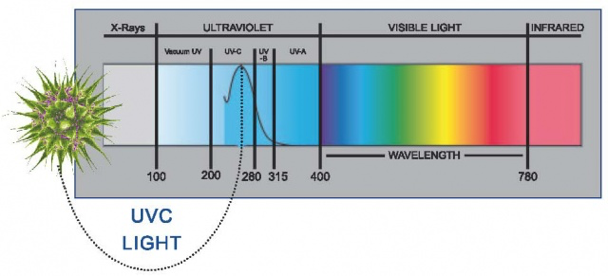
Ultraviolet (UV) light is one form of electromagnetic energy produced naturally by the sun. UV is a spectrum of light just below the visible light and it is split into four distinct spectral areas – Vacuum UV or UVV (100 to 200 nm), UVC (200-280 nm), UVB (280 to 315 nm) and UVA (315 to 400 nm).
What is Ultraviolet C?
The entire UV spectrum can kill or inactivate many microorganism species, preventing them from replicating. UVC energy at 253.7 nanometers provides the most germicidal effect. The application of UVC energy to inactivate microorganisms is also known as Germicidal Irradiation or UVGI.
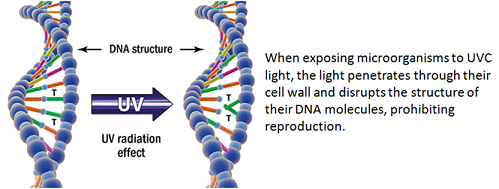
UVC exposure inactivates microbial organisms such as bacteria and viruses by altering the structure and the molecular bonds of their DNA (Deoxyribonucleic acid). DNA is a “blue print” these organisms use to develop, function and reproduce. By destroying the organism’s ability to reproduce, it becomes harmless since it cannot colonize. After UVC exposure, the organism dies off leaving no offspring, and the population of the microorganism diminishes rapidly.
Ultraviolet germicidal lamps provide a much more powerful and concentrated effect of ultraviolet energy than can be found naturally. Germicidal UV provides a highly effective method of destroying microorganisms.
Does UV light sterilize everything in an area?
First, a note on definition. Disinfection and sterilization are both a type of decontamination process, but differ in terms of method and result. Disinfection reduces harmful microorganisms, while sterilization kills all microorganisms. This is an important distinction, because unless we’re in a scientifically controlled environment, we’re not able to sterilize, only disinfect. That said, reducing harmful microorganisms is crucial, and UV light is an effective component in an overall disinfection strategy.
How is UV used in disinfection of a building?
Most likely, you’ve seen images or video of UV disinfection on the news since it’s being used right now in places like airline cabins and subway cars. Those systems are different than what’s used in HVAC air-handling equipment and water filtration, mainly because there are major differences in applications.
Ultraviolet light for germicidal disinfection (UVGD) has one major limit. UV only works in its light path and can be blocked by objects creating shadows. Inline water filters and air handlers work well because we move the particle being disinfected directly across the light path for a specific amount of contact time. That light needs to be in the UV-C wavelength to be effective — blacklights, on the other hand, have a UV-A wavelength and are not effective because the energy won’t be strong enough to penetrate the lipid skin of a cell.
This issue can be minimized by using multiple UV bulbs to generate UV irradiation from different angles, but that would take a lot of time in one small space. Another solution is to use larger robotic disinfection systems. These systems are being used in hospitals and medical research where the cost of the robot units is offset by the potential lost revenue of hospital acquired infections (HAI) if they weren’t used. These robots may be less practical elsewhere, but that doesn’t mean some degree of UV disinfection won’t be helpful.
What about the handheld UV wands now in the consumer market?
These are nice tools, but effectiveness and practicality limitations do exist. First, the light must be hand-waved for a specific length of time over the surface and through the air of the inanimate object being disinfected. This is time consuming, and subject to a lot of human error, whereas electrostatic chemical disinfection can often be completed in a fraction of the time with the same efficacy and cost.
Second, these bulbs often contain high amounts of mercury and can present safety and disposal hazards. Finally, it’s not clear whether these wands on the market are calibrated to the right wavelength all the time. Some may be just blacklights, which do nothing to damage DNA, so that means it wouldn’t be strong enough to penetrate the nucleocapsid of a virus or envelope of other pathogens. Consumers need to do their research when purchasing these tools.
What’s the benefit of installing UV-C lighting in water and air systems?
This is the single point where we control a free-floating molecule and it is for this reason, it may be the most practical application for non-healthcare facilities. Air and water are fluids, we can push or pull those fluids in a very controlled way past a contact surface and use that surface to apply the light.
These systems must be engineered with the proper fixtures, placement, safety, and lamp type based on criteria such as the volume, velocity, humidity of the space, design temperatures, use of space, control surfaces, and a host of other considerations. The benefit is that while air is moved across the filter media, ongoing disinfection occurs.
As buildings become more efficient—in ongoing efforts to save cost and reduce the carbon footprint—newer systems are designed to reuse and recirculate more of that air repeatedly through economizers and return air mixing boxes. This makes inline filtration and disinfection a more important component in the overall effectiveness of a healthy facilities management strategy to reduce harmful pathogens and one that UG2 considers with customers when discussing Engineering4Health as part of our UG2 ReNewSM strategy.
What else should be in place for an efficient disinfection system?
Light from any UV-C filtration in an air handler or water system cannot reach the hard surface in the room. For this reason, this type of system should only be employed alongside other engineering controls and human behaviors as components in a holistic facilities management strategy.
These include an effective janitorial program, a properly trained staff using the correct personal protective equipment, correct social distancing, and well-maintained room pressure and/or isolation based on room occupancy and potential infection levels. And of course, proper hand hygiene.